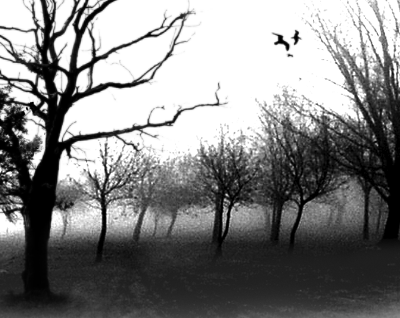
Monday, February 29, 2016

Double Exposure

Danielle
"Double Exposure"
Made in Photoshop CC
February 29th, 2016
&
June 9th, 2016

Technical
TOP:
To start off, I took pictures from the internet, found here: 
I then opened the picture of the person (in my case Evan Peters) and used a layer mask to "hide" everything but him. I then opened the background pictures and placed them where I thought they would look good. I then created layer masks on all the pictures. I Ctrl-clicked the person layer and in the layer masks of the background pictures, "hid" everything outside the selected area. After I was happy with that, I went through the layer blends until I liked how the background pictures looked (but this is not necessary). Next I made a duplicate of the person layer and placed it on top. I then went through the layers blends until I got what I liked, which is the result up top.

BOTTOM:
I took my own pictures and opened them in photoshop. I then played around with the pictures using my memories of my double exposure from February, and got this.
Idea or Concept
TOP:
The first idea that popped into my head was taking a picture of Evan Peters and using dark forest backgrounds to represent Peters' character Tate Langdon from American Horror Story, who is dark and mysterious.

BOTTOM:
I took a picture of my pug Buster and a picture from the Scenic Caves because Buster is quite adventurous. He loves to go on walks in nature and seems to loves trees.
Influences
No artist influenced me on this piece.
Composition
TOP:
I like how my eyes move around the piece. They go from the darker part at the bottom left to the lighter parts, up to the black birds flying above in the white. I also feel that my eyes follow the trees and branches up to the top, which again leads to the birds flying up above.

BOTTOM:
I feel that Buster's lighter face is the center of attention but allows the eye to move on tot he darker green trees in the background.
Motivation
Other than completing this for class, I thought it would be cool what I could create using this technique. I wanted to see if I really could make something like this that appears dark, and mysterious and also another cute picture of my pug. I like how the pieces look overall. With additional time, I would have experimented further and see what else I could create and add to this piece.

Friday, February 26, 2016

Koalaguin


Danielle
"Koalaguin"
Made in Photoshop CC
Feb 26, 2016

Technical
For this work, I took the head of a koala and placed it on top of the penguin's heads. I used layer masks so that I wasn't permanently erasing the pictures and then I posed them on top of the penguin's heads, rotating and flipping to cover the heads.

Idea or Concept
Originally, I was going to use a capybara and I believe a koala for this project. I created a picture I didn't initially like. It ended up getting deleted after issues with the computer. I then took the penguin and koala pictures from the sample picture folder and put them together, resulting in this.

Influences
I did not have any influences for this piece.

Composition
This piece immediately draws the viewers eyes to the koala heads as they are grey in a picture full of blue (and a bit of yellow).

Motivation
Other than completing this as an assignment, I thought it would be cool to try to create a (somewhat realistic) picture where one animal's head is on a different animals body. I think that although the koala heads don't necessarily blend in the best, I think they fit better than I had thought they would. I was surprised how they fit together better than I had expected. With additional time I would figure out a way to blend the Koala heads with the penguin necks better to make it look even a bit more realistic.

Mandala


Danielle
"Mandala"
Made in Photoshop
Thurs, Feb 18th, 2016

Technical
I first opened a picture of a peacock feather in Photoshop CC. I then changed the canvas size by twice the height and moved the picture to the top. I then duplicated the layer and flipped the copy vertically and moved it to the bottom of the page. I then flattened the layers with Ctrl+E. Next I changed the canvas size to twice the width and moved the picture to the right side, then duplicated the layer and flipped it horizontally before moving it to the left. Again I flattened the layers. Next I duplicated the layer and rotated it by 20 degrees. I did the same for the next seven copies (nine layers altogether - eight copies and original layer). Next I selected all the layers and converted them into a Smart Object. After that, I went into Layer - Smart Objects - Stack Mode. I then went through the different Stack Modes and choose the Mandala I liked the best.

Idea or Concept
I didn't really have many ideas with this. I took a picture of a colourful peacock feather from the internet and followed the tutorial, which then resulted in this.

Influences
I didn't have any influences for this project.

Composition
I feel that the different colours that resulted from this make the eye look all around. The greens, pinks and purples (and any other colours hiding in there) mix together wonderfully, creating a colourful piece that is easy on the eye.

Motivation
Other than fulfilling the requirements, I wanted to create a (hopefully) colourful piece that I thought looked nice. I ended up creating multiple that I really liked but settled on this one (the one above) as my absolute favourite. I like the colours. They all go together beautifully. I was surprised by how many different and cool designs I could create with this tutorial. With additional time I would choose different picture and create even more, as there is not much, if anything, that I could do to improve this mandala.

Friday, May 15, 2015

The Corporation Questions

1 ) What is the principal purpose of this documentary?

The purpose of this movie is to make you ask questions about Corporations. It is also to show the development of a "living" business corporation from a legal thing that started as a government-chartered institution, to the rise of the modern commercial institution entitled to the legal rights of an actual person, that it is now. One theme is its assessment of corporations as people, the result of a Supreme Court case in 1886 which led to corporations having the same rights as human beings.

2) What does the film critique? How do you know that?

This movie critiques how all corporations only have "The Bottom Line". How much money can they make? They are to put "The Bottom Line" above everything, including the public good. It's not a law of nature. It's a decision. They care only for the short-term profit. A corporation's only obligation is to themselves. I know this because everyone seems to believe it and it says so in the film.

3) What methods did the filmmaker use to increase public awareness about Corporate responsibility and affect people’s beliefs and behavior?

They interviewed multiple people, some from corporations, and even regular people that were passing by. Through vignettes and interviews, The Corporation examines and criticizes corporate business practices.

4) Which methods of theirs did you think were most effective in supporting their position on corporate responsibility. Why?

I think the interviews are effective enough to support their position on corporate responsibility. I think this because if the people are honest (and why wouldn't they be?), then what they say is really how things are.

5) Did you have any issues with this documentary? What were some parts that you did not agree with, or question. Why?

I did not have any issues with this documentary. I am not interested in any documentaries, and this was no exception. Therefore I did not raise any questions.

6) Describe another film you have watched that had an impact on your values. How and why did that happen?

Honestly, How to Train Your Dragon. It teaches that no one should judge others based on appearance and and rumors. Instead, think positive of others, or don't think about them at all. You also should never underestimate someone. Just because they may seem cold or dark, doesn't mean they an't be kind and caring, and vice-versa.

Monday, May 11, 2015

Ball Bounce Animation


I used Photoshop to create my background and animation. I used a provided sound effect at the end.
I decided to do a ball with a simple "X" design on it, bouncing in a park. It bounces off the ground, then the tree, and then the ground again before exploding like a firework. I did not have an influence for this work, although now I feel like I could've done something darker to go along with my chosen animator (Tim Burton)'s work. In this work, the viewer easily follows the ball as it bounces and "sticks" to the ground and tree to add a realistic effect to it. I thought this project was cool because even though I don't have the best drawing skills, I have always wanted to animate something, and with this I was able to. I think this went very well. I was surprised by how well this turned out. With additional time, I likely would've made the background slightly darker and gothic to match the theme Tim Burton is known for.

Tim Burton

Tim Burton by Gage Skidmore.jpgTim Burton is an American Film director, producer, artist, writer, and animator. He was born in Burbank, California on August 25, 1958. He began as an animator for Walt Disney Pictures, but soon moved on making his own kinds of movies and projects. He is known for his dark, gothic, macabre, and quirky horror and fantasy films. He is most known for:
  • Peewee's Big Adventure
  • Beetlejuice
  • Batman
  • Edward Scissorhands
  • Batman Returns
  • The Nightmare Before Christmas
  • Cabin Boy
  • Ed Wood
  • Batman Forever
  • James and the Giant Peach
  • Mars Attacks!
  • Superman Lives
  • Sleepy Hollow
  • Planet of the Apes
  • Big Fish
  • Charlie and the Chocolate Factory
  • Corpse Bride
  • Sweeney Todd: The Demon Barber of Fleet Street
  • 9
  • Alice in Wonderland
  • Dark Shadows
  • Abraham Lincoln: Vampire Hunter
  • Frankenweenie
  • Big Eyes
  • And the upcoming film: Miss Peregrine's Home for Peculiar Children
He was the animator on "The Fox and the Hound" (1981) and "Tron" (1982)

Corpse Bride Analysis
The setting of the movie is in a small town, with a forest nearby. It is shabby and dark, solemn and reeks of despair, much like most Tim Burton movies. The characters are Victor Van Dort, Corpse Bride, Victoria and Barkis Bittern as the main characters. Their makeup is tired looking, with purple shadows under their eyes, with Victorian-era fashion.
The movie is a stop-motion animation, and most of the scenes are at night, and very dark colours are used in this movie. Tim Burton has used many varieties of shots, and because of the small characters like the worm and the spider, there were a lot of big close-ups. However, they were a lot of zoom ins to signify the shocking factor, like when Barkis Bittern swallowed the laced drink and was dead.
They were mostly shot to shot, straight cuts. The black and white contrast is very high, and ala Tim Burton he used many stripes on his character’s costumes. The camera angles that were mostly used in this movie was also from low angle. The transitions are commonly the continuity shots. This movie is also a sort of musical, because there were several songs played, and the songs composed were very much fitting, as it was haunting, while some are a bit cheeky and contain some dark humour. As usual, his main voice actors are Johnny Depp and Helena Bonham Carter.
There is also montage shots to signify that the character is very laden down with the stress from his parents and his peers. As the scenes are beautiful, there were a lot of establishing shots or long shots that show the character and its surroundings.

Overall, the movie gives a very gothic feel, the stop-motion was flawless, the colour schemes albeit dark goes very well with each other, and paired with the music altogether forms a perfect jigsaw piece of a great movie.
The storyline is where Victor has to be wed with Victoria, who is the only daughter of Lord and Lady Everglot, who decides to marry beneath their status because they are close to being in poverty. Overall the plot is going around one of the seven sins: Greed. Victor, who was nervous about his vows one day before his marriage, practiced on what he thought was a branch, but ended up being the bony finger of a corpse, whom then takes him underground. The corpse bride, Emily was killed before uniting with her lover, who turned out to be Lord Barkiss, who was a greedy and cold man. He stepped in before Victor could take Victoria’s hand in marriage just because he assumed that the Everglotts, being Lords are rich and powerful, but that was not the case.
After marriage, when Lord Barkiss found out that Victoria was not filthy rich, he threw a big tantrum and swore to get something out of the marriage, but then was interrupted by the underground residents, who came up to celebrate the wedding of Victor and Emily, whom Victor has decided to marry because Victoria was already married to Lord Barkiss.

From there we can deduce that Victor has given up hope that he would find anyone like Victoria, and would rather live without his life, and at least make someone happy rather than no one.
In the scene where the underground residents came above the ground, when they approached the people, at first the people were scared. However, it showed a boy, who due to his innocence, can ignore other elements and recognize his grandfather despite the bones and haggardness, and it is thanks to this this boy that the others began to look at the underground residents properly and recognize their loved ones, re-united once again.
This movie symbolizes that love can go beyond the grave, and that karma will come to those who deserves it. It also shows that love is not about status and money, and that true love will find its own way to shine. Although it is quite the typical love concept, Tim Burton put the element of dark fantasy in it that we are blinded to the fact that it is yet another love story.
The clay-like stop animation is very smooth and very symmetrical. The lightings are very “concert”-like, as it shows spot lights of various colours come from all directions; top, bottom left and right, which can be clearly seen in the scene where the bartenders are explaining about Emily’s death to Victor when he was just brought down to the underground. However, this kind of lighting can be seen in various parts of the movie, and it actually used quite often.

Monday, May 4, 2015

Spirited Away Questions

Spirited Away incorporates many elements from classical Western literature and folklore: people who magically turn into pigs (the Odyssey); the hero’s quest; the prohibition against eating the food of the Faerie (Irish folkore); a girl who goes to Grandma’s house (“Red Riding Hood”); the need to solve riddles. Do these familiar elements make the story easier to understand, or does their appearance in a Japanese film make them too alien to be helpful?

  • I'm not sure. I didn't notice any references to classical Western fairy tales, so I guess that means it may be too alien.
Does it make sense to think of bodies of water as possessing spirit? Have you ever had a relationship with a river, a pond, an ocean, or the rain that prompted you to speak to water? Have you ever been rescued by a body of water? Have you ever cleaned a body of water?


  • I think it could be believable that bodies of water are possessing spirits. I have (I guess) had a close relationship to a lake by my grandma's house, but not close enough I would talk to it. I have never been saved by a body of water. I also don't remember having cleaned a body of water.